Mekong Delta's Saltwater Intrusion Hits a Decade High as Vietnam Presses China and Laos on Dam Releases
Record saltwater intrusion in Vietnam's Mekong Delta has cut irrigation to tens of thousands of hectares of rice, pushing Hanoi to request emergency releases from upstream dams in China and Laos.
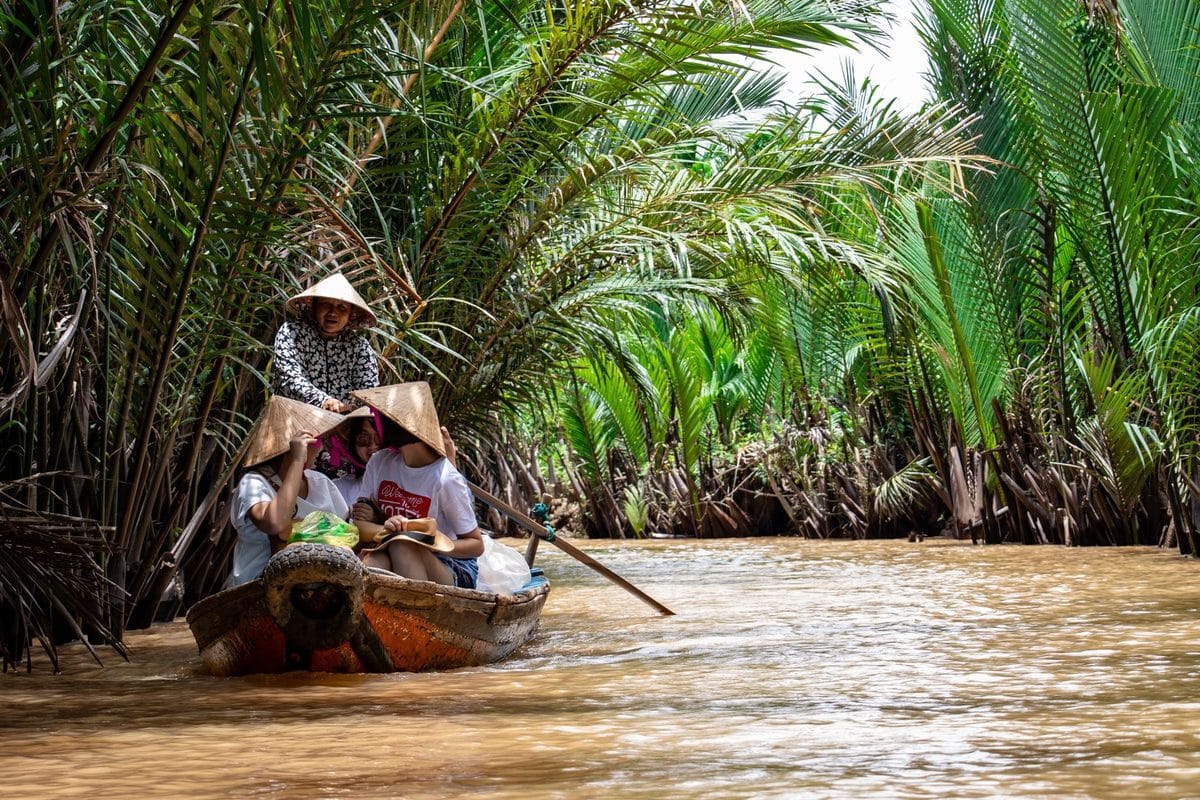
Salinity in Vietnam's Mekong Delta pushed further inland than at any point in the past ten years this week, according to the Vietnam National Mekong Committee, forcing three provinces to shut freshwater intake gates and prompting Hanoi to press China, Laos and Thailand for emergency releases from upstream dams. The intrusion, measured at up to 65 kilometres up the Hau and Co Chien rivers as of September 16, has already cut irrigation to roughly 38,000 hectares of the delta's autumn-winter rice crop, provincial agriculture officials in Ben Tre and Tra Vinh said.
The timing is unusual. Saltwater typically peaks in the delta during the February-to-April dry season and recedes once the wet season raises upstream flow; this year's intrusion has instead intensified through September, the seam between dry and wet seasons, catching farmers mid-harvest. The Mekong River Commission's Secretariat in Vientiane confirmed on September 17 that mainstream flow at the Kratie gauge in Cambodia was running about 22% below the ten-year median for the date.
Salinity Reaches a Ten-Year High Inland
Monitoring stations run by Vietnam's Southern Institute of Water Resources Research recorded salinity of 4.2 grams per litre at Mo Cay Nam in Ben Tre province on September 14 — above the 4-gram threshold at which rice paddies suffer yield loss, and roughly double the reading recorded at the same station on the same date in 2025. Three coastal districts in Tra Vinh switched their public water supply to stored reservoir water after river intake points registered salinity too high for treatment plants to process economically.
The provinces most affected share a common geography: they sit closest to the delta's coastal mouths, where reduced freshwater discharge lets tidal seawater push further upriver.
- Ben Tre — four of nine districts under a provincial water-emergency declaration since September 10
- Tra Vinh — freshwater intake suspended at four points along the Co Chien and Hau rivers
- Soc Trang — shrimp farmers report elevated salinity is actually helping brackish-water ponds, even as it damages rice fields inland, a split outcome the provincial agriculture department flagged in its September 12 bulletin
- Kien Giang — U Minh Thuong district reported saltwater reaching sluice gates roughly three weeks earlier than the 2016–2020 average
Can Tho University's Mekong Delta Development Research Institute estimates that if intrusion holds at current levels through early October, total rice-area losses across the delta could reach 60,000 hectares — a figure the institute's director, Dr. Le Anh Tuan, cautioned depends heavily on whether upstream reservoirs release additional water before the next lunar high-tide cycle around September 27.
Vietnam's Request to Upstream Dam Operators
Vietnam's Ministry of Agriculture and Environment submitted a formal request on September 15 through the Lancang-Mekong Cooperation mechanism, asking China's Ministry of Water Resources to increase discharge from the Jinghong and Nuozhadu dams on the upper Mekong, known in China as the Lancang. A near-identical request went to Laos's Ministry of Energy and Mines regarding the Xayaburi and Don Sahong dams, both of which sit on the mainstream closer to the delta than any Chinese facility.
Beijing's Ministry of Water Resources has not issued a public response as of September 18. Laos's state utility, Électricité du Laos, said in a brief statement carried by the Vientiane Times that it was "reviewing operational schedules in coordination with downstream partners" — language that stops short of a commitment.
A Cooperation Mechanism With No Binding Authority
The Lancang-Mekong Cooperation framework, in place since 2016, allows China to share hydrological data and coordinate seasonal releases with the five downstream countries, but it carries no enforcement mechanism and no obligation to prioritise ecological flow over domestic power demand. The Mekong River Commission itself — whose members are Cambodia, Laos, Thailand and Vietnam — has similarly limited authority: it can request consultation on projects affecting shared flow, but member states have repeatedly built and operated dams without waiting for the Commission's review process to conclude.
The Stimson Center's Mekong Dam Monitor programme, which tracks reservoir levels using satellite altimetry, reported on September 16 that combined storage across the eleven mainstream dams on the Lancang cascade stood at roughly 74% of capacity — high enough, the programme's analysts noted, that a release large enough to meaningfully raise delta salinity dilution would not threaten China's own hydropower generation targets for the remainder of the year.
Why the 2026 Dry Season Hit This Hard
Rainfall across the upper Mekong basin in Yunnan and northern Laos ran below the long-term average for a second consecutive year, according to preliminary figures cited by the Mekong River Commission's July hydrological bulletin, following a weak La Niña pattern that failed to deliver the monsoon rainfall increases typically associated with it. Reduced rainfall alone would not explain intrusion this severe — the delta has weathered drier years without salinity reaching current levels — but water managers at the Southern Institute of Water Resources Research point to a compounding factor: sediment starvation.
Decades of upstream dam construction have trapped an estimated 90% of the sediment that once reached the delta naturally, according to a 2022 study the institute still cites as its most recent full sediment survey. Less sediment means the riverbed and delta plain no longer build up the way they once did, so the same volume of seawater now reaches further inland than it would have a generation ago. Groundwater extraction for aquaculture and irrigation has also lowered land elevation across parts of the delta by several centimetres a year in the worst-affected districts, compounding the effect further.
Rice and Shrimp: A Split Economic Picture
The economic impact is not uniform across sectors. The Vietnam Food Association estimates the delta supplies roughly half of the country's rice output and nearly all of its rice exports, so a 60,000-hectare loss would represent a small fraction of national output but a concentrated blow to the specific communes affected, many of which depend on the autumn-winter crop for a third of annual household income.
Shrimp farmers in Soc Trang and Bac Lieu, by contrast, have in some cases welcomed the higher salinity, since brackish water suits black tiger and whiteleg shrimp better than the lower-salinity conditions that prevail most of the year. The Vietnam Association of Seafood Exporters and Producers noted in a September bulletin that early estimates suggest a modest uptick in stocking density in coastal ponds, though it cautioned that a sudden shift in salinity carries its own disease risk for shrimp already in early growth stages, and that farmers switching practices mid-cycle face higher input costs regardless of the outcome.
What the Commission's Next Meeting Could Change
The Mekong River Commission's Joint Committee is scheduled to meet in Phnom Penh in the first week of October, with dry-season water management high on the agenda after Vietnam formally raised the September intrusion event at a preparatory session on September 17. Cambodia and Thailand, both of which draw irrigation water from the same mainstream, are expected to back Vietnam's push for a standing early-release protocol tied to salinity thresholds rather than the current system of ad hoc, case-by-case requests.
Whether China, which participates in Commission dialogues as a dialogue partner rather than a full member, agrees to any binding data-sharing or release commitment at that meeting remains the open question shaping how the delta's next dry season plays out.